Disc Herniation: What You Need to Know (And Why It Doesn't Have to Be Scary)
Hearing that you have a "disc bulge," "disc herniation," or "disc protrusion" can be intimidating. These terms are often used interchangeably to describe a disc injury in the spine, and while they sound serious, they don't always require surgery. In fact, many people recover very well with conservative treatment.
A spinal disc acts like a cushion between the bones (vertebrae) of your spine. When the soft inner portion of the disc pushes outward through the tougher outer layer, it can irritate nearby tissues or nerves, leading to pain.
A classic story we hear from patients goes something like this:
"I bent over to pick something up, felt a pop in my back, and suddenly I couldn't stand up straight."
If that sounds familiar, take a deep breath. Disc injuries are common, and with the right treatment plan, they often improve significantly.
Common Symptoms of a Disc Herniation
Disc injuries can look different from person to person, but common symptoms include:
Low back pain
Pain traveling into the buttock or down the leg (sciatica)
Numbness or tingling in the leg or foot
Muscle tightness or spasms in the low back
Weakness in the leg in more significant cases
The location of your symptoms often depends on whether the injured disc is irritating a nearby nerve.
Understanding the Different Stages of A Disc Injury
A spinal disc has two main parts:
Nucleus pulposus: the soft, gel-like center
Annulus fibrosus: the tough outer ring
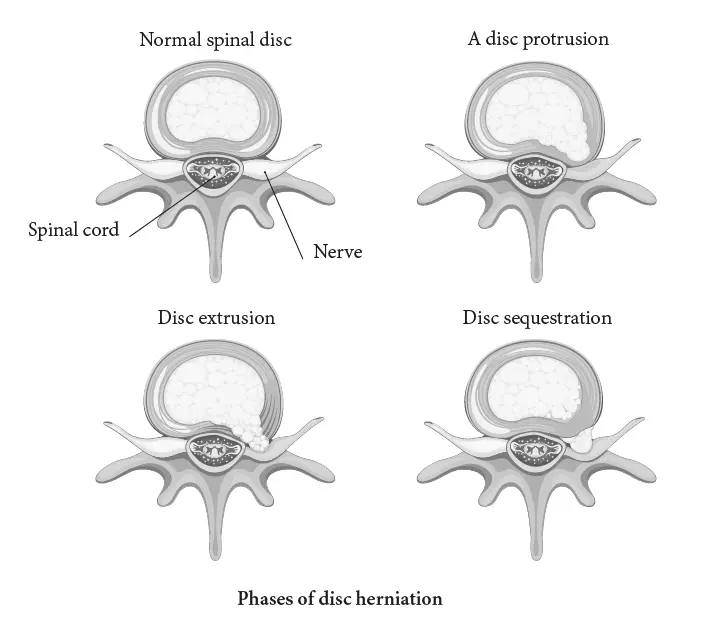
Disc Bulge
In the earliest stage, the inner portion of the disc begins pressing outward against the annulus. The annulus contains pain-sensitive fibers, so even without a true herniation, this pressure can cause significant back pain.
Disc Protrusion (Herniation)
As more pressure builds, the disc may begin protruding outward. At this stage, the disc can start narrowing the space around nearby spinal nerves.
Nerve Compression
When the disc presses on a spinal nerve, pain may begin traveling down the leg. This is known as radiculopathy or sciatica, and may include:
Burning pain
Sharp shooting pain
Numbness
Tingling
Weakness
Disc Extrusion
In some cases, the inner nucleus pushes completely through the outer layer of the disc.
This is important because the nucleus is highly inflammatory. Under normal circumstances, your immune system never comes into contact with it. When the nucleus escapes the disc, your immune system recognizes it as foreign and releases inflammatory chemicals into the area. This inflammatory response can significantly increase pain during the early stages of healing.
When Should You Seek Care?
One of the biggest mistakes people make is waiting too long.
Many people experience mild back pain for months or even years before a major flare-up occurs. Because the pain comes and goes, it's easy to dismiss it as "just getting older."
Addressing pain early often leads to better outcomes. Learning proper lifting mechanics, improving movement patterns, strengthening the surrounding muscles, and correcting the underlying cause can help prevent future injuries before they become more severe.
Seek Emergency Care Immediately If You Experience:
Seek Emergency Care Immediately If You Experience:
Loss of bowel or bladder control
Numbness around the groin or inner thighs ("saddle anesthesia")
Rapidly worsening weakness in the legs
These symptoms may indicate Cauda Equina Syndrome, a rare but serious medical emergency that requires immediate evaluation.
How Long Does A Disc Herniation Take To Heal?
The good news is that discs are capable of healing.
Research has shown that many patients experience excellent long-term outcomes with conservative care, often comparable to—or better than—more invasive treatments such as surgery, depending on the severity of the injury.
Soft tissue healing generally takes 6–8 weeks, although everyone's recovery is different.
One encouraging sign we look for during treatment is called centralization.
This means your symptoms gradually move from traveling down the leg back toward the low back. Even if your back still aches, having less pain, numbness, or tingling in your leg is typically a sign that you're moving in the right direction.
Our Treatment Approach
No two disc injuries are exactly alike, which is why treatment should never be one-size-fits-all.
Depending on your examination findings, treatment may include:
Chiropractic care
Specific therapeutic exercises
Movement modification
Education on proper lifting and body mechanics
Fascial work and soft tissue treatment
A progressive rehabilitation plan
It's important to remember that exercises you find online—or in the latest viral TikTok video—may not be appropriate for your specific injury. In some cases, they can actually make symptoms worse.
During the acute phase, inflammation can sometimes become so severe that movement itself is nearly impossible. If this happens, your healthcare provider may recommend a short course of prescription anti-inflammatory medication, such as a steroid pack, to calm the inflammation enough for rehabilitation to begin.
Nutrition Matters More Than You Think
Inflammation plays a major role in how painful a disc injury feels.
While nutrition won't "fix" a herniated disc overnight, reducing inflammatory foods may help create an environment that supports healing.
For the next two weeks, focus on whole, minimally processed foods while reducing or eliminating:
Added sugars
Processed grains (cookies, cakes, pastries, white bread)
Alcohol
Dairy (if it worsens your symptoms)
Highly processed foods
Eating plenty of vegetables, lean protein, healthy fats, and whole foods can help support your body's natural healing process.
The Bottom Line
A disc herniation can be painful, frustrating, and even frightening—but it doesn't have to define your future. With the right diagnosis, an individualized treatment plan, and consistency, many people recover well without surgery and return to the activities they love.
If you're dealing with back pain, sciatica, or think you may have a disc injury, don't wait until it becomes debilitating.
At Bloom Chiropractic, we focus on finding the root cause of your pain—not just treating the symptoms. Through personalized chiropractic care, movement-based rehabilitation, fascial work, and education, we'll help you reduce pain, restore function, and get back to doing what you love.
If you're ready to take the first step toward feeling better, we'd love to help. Give Bloom Chiropractic a call or schedule your consultation today. Your recovery starts here.


Comments